The Gently Mad Book Shop
Ben Hecht : Fantazius Mallare + The Kingdom of Evil : Dark Weird : Arkham House
Ben Hecht : Fantazius Mallare + The Kingdom of Evil : Dark Weird : Arkham House
Couldn't load pickup availability
Fantazius Mallare + The Kingdom of Evil
By Ben Hecht
Fantazius Mallare was published by Covici-McGee, Chicago, 1922. First Edition. Limited edition of 2000 copies, this one numbered 870. Hardback book in original dust jacket. Tall 8vo. 174pp. With10 full page illustrations by Wallace Smith.
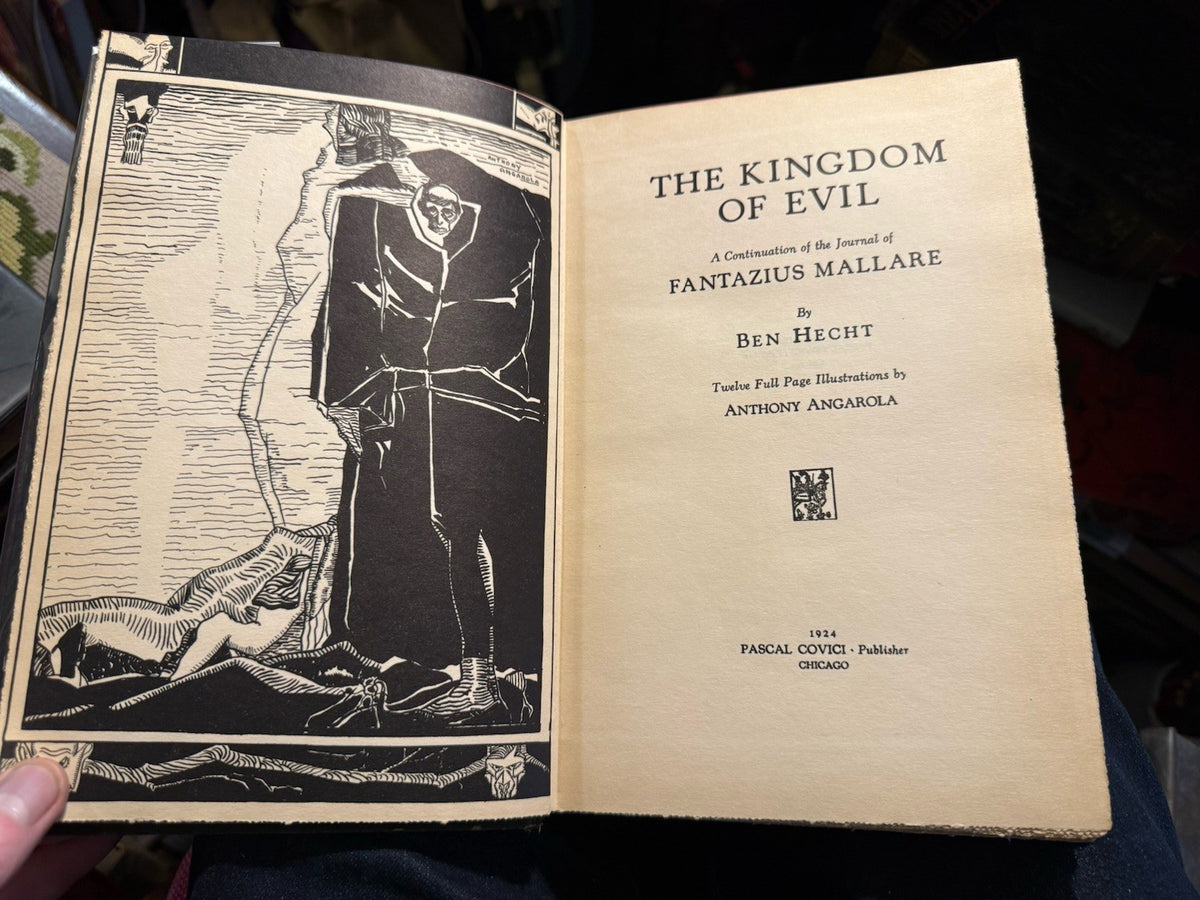
The Kingdom of Evil was published by Pascal Covici, Chicago, 1924. First Edition. Limited edition of 2000 copies, this one numbered 1945. Hardback book in original dust jacket. Tall 8vo. 211pp. With 12 full page illustrations by Anthony Angarola.
PROVENANCE
From the library of Donald Wandrei, author and co-founder of Arkham House Publishers. His small bookplate is found to the inside board of Fantazius Mallare. He has also signed the front endpaper and dated it 1927.
CONDITION
Both volumes are in very good condition. The dust jacket for Fantazius has a chip from the bottom edge of the front and samll chips to the spine ends and corners but is otherwise very good. The dust jacket for The Kingdom of Evil is in fine condition with no chips or tears. Both jackets are protected with removable archival sleeves. Boards and spines very clean. Endpapers very good and inner hinges to both books remain sound. All contents present including all illustrations by Smith and Angarola. Pages clean throughout both books. Overall both books can be considered in very good+ condition.
SYNOPSIS
"Fantazius Mallare" and "The Kingdom of Evil" is a dark narrative that explores themes of madness, egoism, and the nature of reality through its main character, Ben Fantazius Mallare. A thirty-five-year-old sculptor with a disdain for reason and sanity, Mallare sees himself as a superbeing, striving for god-like control over others, particularly women. His relationships are marked by violence and delusion, as illustrated by his interactions with Rita, an eighteen-year-old gypsy girl whom he attempts to dominate and later brutally assaults.
The story transitions into "The Kingdom of Evil," where Mallare's psyche manifests as a prison run by a giant named Dr. Sebastien, who holds other men captive to entertain his lover, Kora. Central to this section is the revelation that all characters are extensions of Mallare's own mind, illustrating his struggle with desire and identity. As the narrative unfolds, Julian, a poet, recognises his own existence as a figment of Mallare's imagination, prompting a quest for escape from the madness that envelops them. The tale ultimately delves into the complexities of self-awareness, control, and the interplay between creator and creation, leaving readers to ponder the boundaries between reality and illusion.
The Government Trap and Obscenity Trial
The release of Fantazius Mallare: A Mysterious Oath in 1922 sparked a massive 1920s free-speech battle, landing Ben Hecht and his illustrator in federal court. Hecht did not just stumble into a scandal, but instead actively engineered a trap for federal censors. Partnering with artist and Hearst journalist Wallace Smith, Hecht intentionally wrote a work of highly stylised erotica. Smith provided ten baroque, intensely graphic drawings heavily inspired by the decadent style of Aubrey Beardsley.
The plan backfired spectacularly when the government took the bait: The U.S. Post Office confiscated the limited run of 2,000 hardcover copies, branding the book "lewd, lascivious and obscene" and charging Hecht with defiling the United States mails. Ironically, historical accounts note that the specific word that truly enraged federal censors was "pissing". The Legal Defeat: Hecht originally wanted a theatrical, highly publicized show-trial to defend the First Amendment. He even managed to secure the legendary defence attorney Clarence Darrow. However, as broader literary and defence support collapsed, Hecht and Smith were forced to abandon the trial and plead nolo contendere (no contest). They were both convicted and hit with a massive $1,000 fine (over £15,000 today).
The Aftermath
The fallout from the book completely upended Hecht's life but arguably set his legendary career into motion. The scandal caused The Chicago Daily News to fire Hecht from his prominent newspaper job. Out of work but enjoying the notoriety, Hecht teamed up with poet Maxwell Bodenheim to launch the Chicago Literary Times—a short-lived, deeply satirical, bohemian avant-garde newspaper. The censorship also supercharged sales, turning the banned book into an instant underground collector's item. Hecht defiantly followed it up two years later with The Kingdom of Evil. To avoid further issues with Wallace Smith's "obscene" artwork, Hecht hired Anthony Angarola to handle the visuals for the sequel.
(Desk / Top Shelf / Right)